

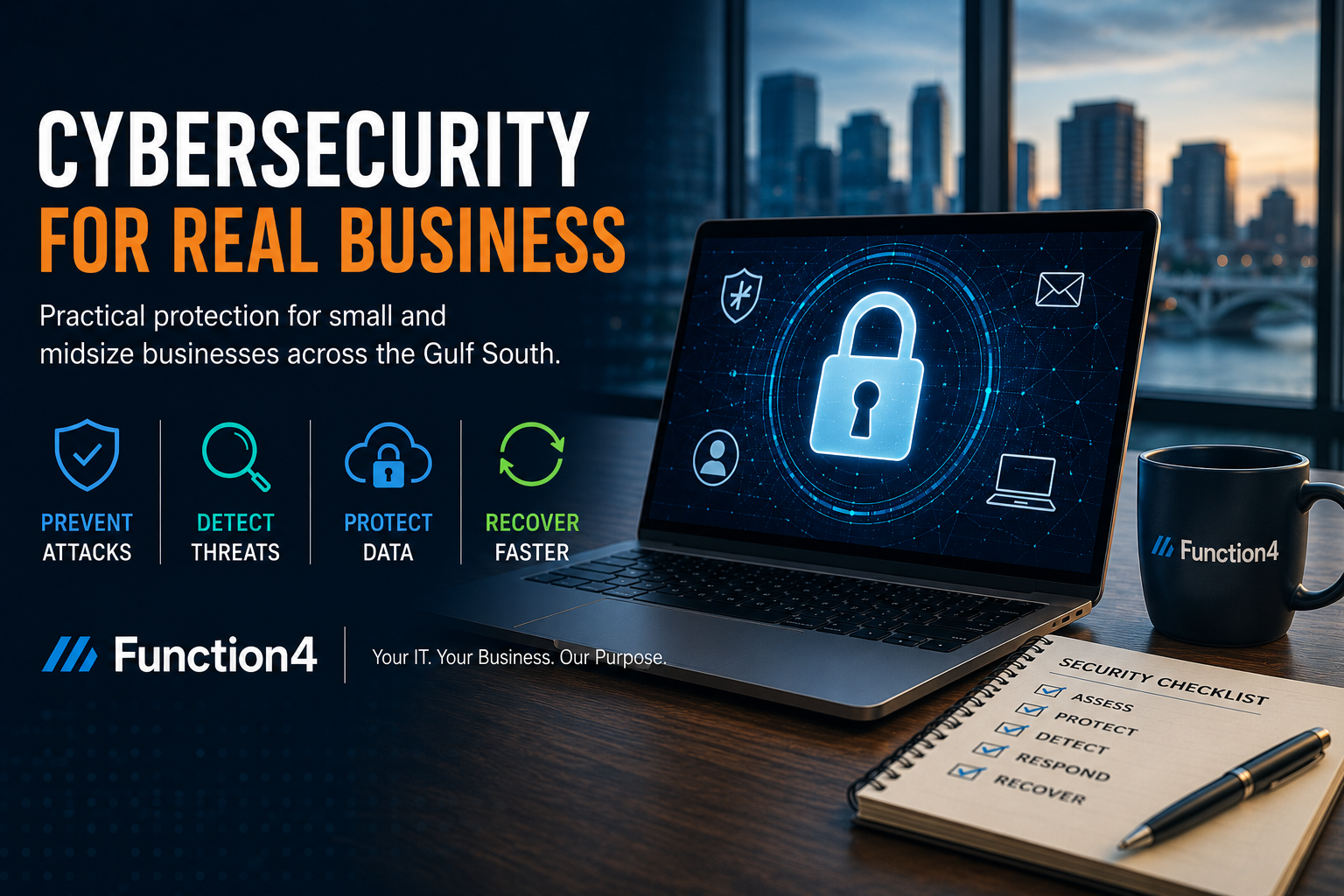
Most businesses don’t think seriously about cybersecurity until something goes wrong. Wrong order. By the time encrypted files show up, or someone’s asking why your systems are spamming their inbox, you’re already in recovery mode. This guide covers what computer security looks like for real businesses. Not enterprise corporations with dedicated security teams. The companies that actually make up most of the Gulf South economy.
Key Takeaways
- Small and midsize businesses get targeted more often than large enterprises, not less
- Most breaches come through three doors: phishing, weak credentials, and unpatched software
- The cost of a cyberattack almost always exceeds the cost of prevention — often by a wide margin
- Compliance and security aren’t the same thing — passing an audit doesn’t mean you’re protected
- Managed IT services give SMBs access to enterprise-grade monitoring without the enterprise payroll

Why Your Business Is a Target
Attackers aren’t just going after the big names.
Small and midsize businesses get hit constantly.The FBI’s Internet Crime Complaint Center reports billions in annual losses from business email compromise and ransomware alone — the FBI IC3 Annual Report documents the full scope each year.
Why? They’re easier. A 40-person company probably doesn’t have 24/7 network monitoring. Probably doesn’t have a dedicated security team. Definitely doesn’t have tested incident response procedures. Attackers know that. They’re not hunting for the hardest target. They want the most profitable one relative to how much work it takes.
And it’s not always about your data. Sometimes a smaller business gets compromised because it works with a larger one. The real goal is a foothold into a more valuable network. You don’t have to be the prize to end up in the breach report.
The Attacks You’re Most Likely to Face
Not all threats carry equal weight. These are the ones businesses actually encounter — and the cybersecurity threats facing small businesses in 2026 keep shifting as attackers adapt.
Phishing and Social Engineering
It’s still the most common way attackers get in. An email shows up that looks like it’s from your bank, your software vendor, your CEO. Someone clicks. Credentials get stolen, or malware gets downloaded, or $40,000 gets wired to the wrong account.
Modern phishing doesn’t look like the obvious broken-English scam anymore. Spear phishing targets specific people. Attackers scrape LinkedIn, company websites, previous breaches. The email references a real project name, a real vendor, sometimes a real colleague’s name. That’s what makes it work.
Business email compromise is the version that costs the most. Someone impersonates an executive. Finance gets an urgent wire transfer request. No malware. No link to click. Just a convincing email and a process that didn’t require a second confirmation.
Ransomware
Files get encrypted. Operations stop. Then comes the demand.
Ransomware groups don’t just fire off mass attacks anymore. They get into a network and sit there. Weeks, sometimes months. They map the systems, find the critical ones, escalate their access level. When the encryption finally triggers, they’ve already positioned it to hurt as much as possible. Some groups pull the data out first. Then they can threaten to publish it even if you restore from backup.
Paying doesn’t guarantee recovery. It does guarantee the attackers get paid.
Credential Attacks
Passwords get leaked in breaches all the time. Those credentials get packaged and sold. Then attackers test them against every major platform to see what else they unlock. If someone uses the same password for their work email and a shopping account that got breached three years ago, that’s a problem waiting to happen.
Multi-factor authentication closes most of this gap. But MFA fatigue attacks — where attackers flood a user with authentication requests until they approve one just to make it stop — have become a real workaround. It’s not enough to have MFA. It has to be the right kind, implemented correctly.
Outdated Software
Every piece of unpatched software is a known vulnerability with a known fix that hasn’t been applied. Attackers scan for these. They’re not exploiting mystery techniques — they’re walking through doors that should have been locked months ago.
This is one of the clearest arguments for managed IT services. Proactive patch management means someone is responsible for keeping systems current. Without it, patches pile up or get skipped entirely, and the attack surface grows. For a broader look at how unresolved IT issues compound over time, see our guide to technical debt and IT budget planning.
What a Breach Actually Costs
The ransom number, if there is one, is usually not the biggest expense.
Downtime is. When systems go offline — because of ransomware, a destructive attack, or the shutdown required to contain an incident — revenue stops. Deadlines get missed. Staff can’t work. For professional services firms, healthcare practices, or anyone with time-sensitive obligations, even a few days offline is a serious financial event. IBM’s Cost of a Data Breach Report consistently identifies lost business as the largest single component of total breach costs.
Then there’s remediation. Forensic investigation, system restoration, outside incident response support — none of it is cheap. A ransomware recovery, even with backups available, can easily cost tens of thousands of dollars in staff time and outside support before the business is fully operational again.
Regulatory exposure adds another layer for certain industries. A HIPAA violation can run from a few hundred dollars per incident to hundreds of thousands, depending on negligence level and the volume of records exposed. PCI DSS non-compliance creates its own set of fines and merchant agreement consequences.
And reputational damage. That one doesn’t show up on an invoice, but it shows up in client conversations. Some businesses never fully recover the trust they lose after a public breach.
A cybersecurity assessment costs a fraction of what a single incident response engagement runs. That math isn’t complicated.
The Layers That Actually Protect a Business
There’s no single tool that handles cybersecurity. It’s always a set of controls working together — so if one fails, something else is already in position.
Endpoint Protection
Every device connecting to your network is a potential entry point. Laptops, desktops, phones, tablets — all of it. Modern endpoint detection and response (EDR) tools don’t just look for known malware signatures. They monitor behavior. An application that starts making unusual system calls at 2am, a process that begins accessing files it’s never touched before — those are the signals that matter.
Network Monitoring
A firewall sets the perimeter. But what happens inside the perimeter matters too. Network monitoring tools watch traffic patterns, flag anomalies, and catch things like lateral movement — where an attacker who’s already inside starts moving from system to system looking for more access. Without visibility into what’s happening on your network, you’re working blind.
Identity and Access Management
Who has access to what, and how is that access verified? Multi-factor authentication should be on every business-critical system — email, financial platforms, cloud applications. Role-based access controls make sure employees can only reach what their jobs actually require. When someone leaves the company, access gets revoked. These aren’t complicated controls. They’re consistently skipped.
Backup and Recovery
Cloud backup services don’t prevent attacks. But they change the outcome significantly when an attack happens. Clean, recent, tested backups are the primary defense against ransomware leverage. The key word is tested — a backup you’ve never tried to restore from is an assumption, not a recovery plan.
Dark Web Monitoring
Credentials and sensitive data circulate on dark web marketplaces for months, sometimes years, after a breach. Dark web scanning checks for your company’s information in those places so you can act before attackers do. A leaked employee password found today is a forced reset. Found six months from now — after someone’s used it — is an incident report.
Incident Response Planning
What happens when something goes wrong? Who gets called? Who has authority to take systems offline? What are the regulatory notification timelines? Which vendors support forensic investigation?
Companies with a documented, tested incident response plan contain breaches faster and spend less recovering from them. Plan it in advance. Not after.
Compliance Isn’t the Same as Security
Regulated industries have specific requirements, and they matter. But passing an audit is not the same as being protected.
HIPAA requires healthcare-adjacent businesses to put administrative, physical, and technical safeguards in place. Appropriate to their actual risk profile. Plus documented security risk assessments, at minimum annually. Violations carry civil monetary penalties that scale with how negligent the lapse was.
PCI DSS applies to any business processing, storing, or transmitting card data. Most retailers. Many service businesses. Requirements include network segmentation, encryption, access controls, and regular vulnerability scanning.
Texas Business & Commerce Code Chapter 521 requires reasonable cybersecurity procedures and breach notification to affected Texas residents within 60 days.
Compliance frameworks reflect when they were written. Attackers don’t wait for the next standards update. Meeting your compliance requirements and stopping there means meeting a floor, not a ceiling.
People Are Still the Biggest Variable
No technology stack fully compensates for an untrained workforce.
Security awareness training isn’t a once-a-year video. Effective programs run simulated phishing campaigns — employees receive test phishing emails, and those who click get coached in the moment. Over time, the click rate drops. That’s measurable. That’s real risk reduction.
“At Function4, we believe in making technology an asset — not an obstacle — for our clients,” says Chris LeMay, CEO of Function4. That applies directly here. Security training that frustrates employees doesn’t work. It gets ignored, worked around, or tolerated without sticking.
A few things that actually move the needle:
- Password managers solve the usability problem that leads to passwords on sticky notes. Complex passwords people can’t remember are a security liability, not an asset
- A reporting culture where employees feel comfortable flagging suspicious emails or incidents — without fear of being blamed for clicking
- Consistent, brief communication about current threats. Not annual training. Ongoing awareness
Leadership sets the tone. If executives don’t comply with MFA requirements or share credentials casually, the rest of the organization will follow that example. Not the policy — the behavior.
What Managed IT Means for Cybersecurity
Most SMBs can’t hire a full-time security analyst. The talent market is competitive. The cost is real. But going without isn’t the only alternative — and the real choice usually comes down to managed IT services versus a break-fix approach.
Managed IT services cover the operational security functions most SMBs need but can’t staff internally. Around-the-clock monitoring, patch management, threat detection, incident support. It’s not a replacement for a strategy. It’s how you run one without building a security team from scratch.
Function4’s help desk support gives employees a direct path when something looks off. The time between an employee noticing something and IT actually knowing about it is often where a contained incident becomes a serious one. Shorten that gap, and outcomes change.
For businesses without a formal security review, a cybersecurity assessment is where to start. It maps what you have. Finds the gaps. Tells you what to fix first. No assessment means no baseline. And without a baseline, you’re guessing.
Frequently Asked Questions
Cybersecurity Basics for Business Owners
Do small businesses really need cybersecurity, or is it mainly a concern for large companies?
Small and midsize businesses get targeted more often than large enterprises in many attack categories, largely because they’re seen as easier to breach. Any business handling customer data, processing payments, or depending on operational continuity needs a security posture — size doesn’t change that.
What’s the difference between cybersecurity and IT security?
The terms get used interchangeably, and in most business conversations they refer to the same set of concerns: keeping systems, data, and networks protected from unauthorized access or attack.
How do I know if my business has already been compromised?
Unexpected slowdowns, unfamiliar user accounts, unusual financial transactions, employees getting password reset emails they didn’t request — these are common signals. Many breaches go undetected for weeks, which is why continuous monitoring matters more than periodic check-ins.
What’s the first thing a business should do to improve its cybersecurity?
Start with a risk assessment. You can’t prioritize fixes without knowing what’s actually exposed — and most businesses are surprised by what a formal assessment finds.
Is cybersecurity insurance a substitute for actual security?
No. Insurers are increasingly requiring documented security controls before issuing policies, and claims can be denied if basic safeguards weren’t in place at the time of an incident. Insurance transfers some financial risk. It doesn’t reduce the probability of an attack.
Common Threats and How Businesses Get Hit
What makes phishing so hard to defend against?
Modern phishing emails are built with real details — actual project names, real vendor relationships, sometimes a real colleague’s name — pulled from public sources or previous breaches. They’re convincing because they’re researched.
What should a business actually do if ransomware hits?
Isolate affected systems from the network immediately to stop the spread, then contact your IT provider or managed security team before doing anything else. Don’t pay the ransom without professional guidance — there’s usually a better path.
Does multi-factor authentication actually make a meaningful difference?
Yes — it’s one of the highest-impact controls available at any budget level. Even if an attacker gets a password, MFA blocks access without the second factor.
What’s credential stuffing, and should my business be worried about it?
Attackers take username-password combinations leaked in previous data breaches and test them against other platforms automatically. If employees reuse passwords across personal and work accounts, your business is already exposed.
How do insider threats typically happen?
Sometimes it’s malicious — a departing employee exfiltrating data. More often it’s accidental — someone clicking a link or sharing credentials to solve a problem quickly. Both require the same response: least-privilege access and behavioral monitoring.
Compliance and Legal Requirements
What cybersecurity obligations do Texas businesses have under state law?
Texas Business & Commerce Code Chapter 521 requires businesses to implement reasonable cybersecurity procedures and notify affected residents within 60 days of discovering a qualifying breach. It’s a floor, not a complete framework.
Does HIPAA apply to businesses that aren’t hospitals or clinics?
Yes — any business associate handling protected health information on behalf of a covered entity falls under HIPAA’s Security Rule, including billing companies, IT vendors, and transcription services.
What is PCI DSS, and does it apply to my business?
PCI DSS applies to any business that processes, stores, or transmits credit or debit card data. Most retailers and many service businesses are subject to it through their merchant agreements.
What’s the difference between being compliant and being secure?
Compliance means meeting documented minimum standards at a point in time. Security means defending against current threats, which evolve faster than standards do. A business can pass every audit and still be open to a modern attack.
How often should a business do a formal cybersecurity assessment?
Annually at minimum, and after any significant operational change — a major software migration, an acquisition, a move, or a shift in how the business handles data.
Getting Help and Choosing the Right Partner
What should a business look for when hiring a cybersecurity services provider?
A provider that starts with a risk assessment before recommending anything, demonstrates familiarity with your industry’s regulatory environment, and can clearly explain what they monitor and how fast they respond.
What does a managed cybersecurity service actually cover day to day?
Typically: continuous network and endpoint monitoring, automated patch management, threat alerting, vulnerability scanning, and incident response support. More comprehensive programs add dark web monitoring and compliance reporting.
How is a cybersecurity assessment different from a vulnerability scan?
A vulnerability scan is automated and identifies known software weaknesses. An assessment is broader — it evaluates policies, procedures, access controls, and human factors, then produces a prioritized remediation roadmap.
Can Function4 help with HIPAA or PCI DSS compliance specifically?
Yes — Function4 works with businesses in regulated industries to align their environments with compliance requirements, including risk assessments, technical control implementation, and ongoing monitoring.
How do we get started if we’ve never had a formal security review?
A free consultation is the right first step — a conversation about your current environment and specific concerns. From there, a cybersecurity assessment establishes a real baseline and a practical roadmap.
Protect What You’ve Built
Computer security services from Function4 cover the full range of what businesses across the Gulf South actually need — monitoring, patch management, dark web scanning, cybersecurity assessments, and incident response support — without requiring an in-house security team. Security is one layer of a bigger picture — our complete guide to IT services for business shows how it fits alongside support, infrastructure, and daily operations.
Contact Function4 to schedule a free consultation.
