





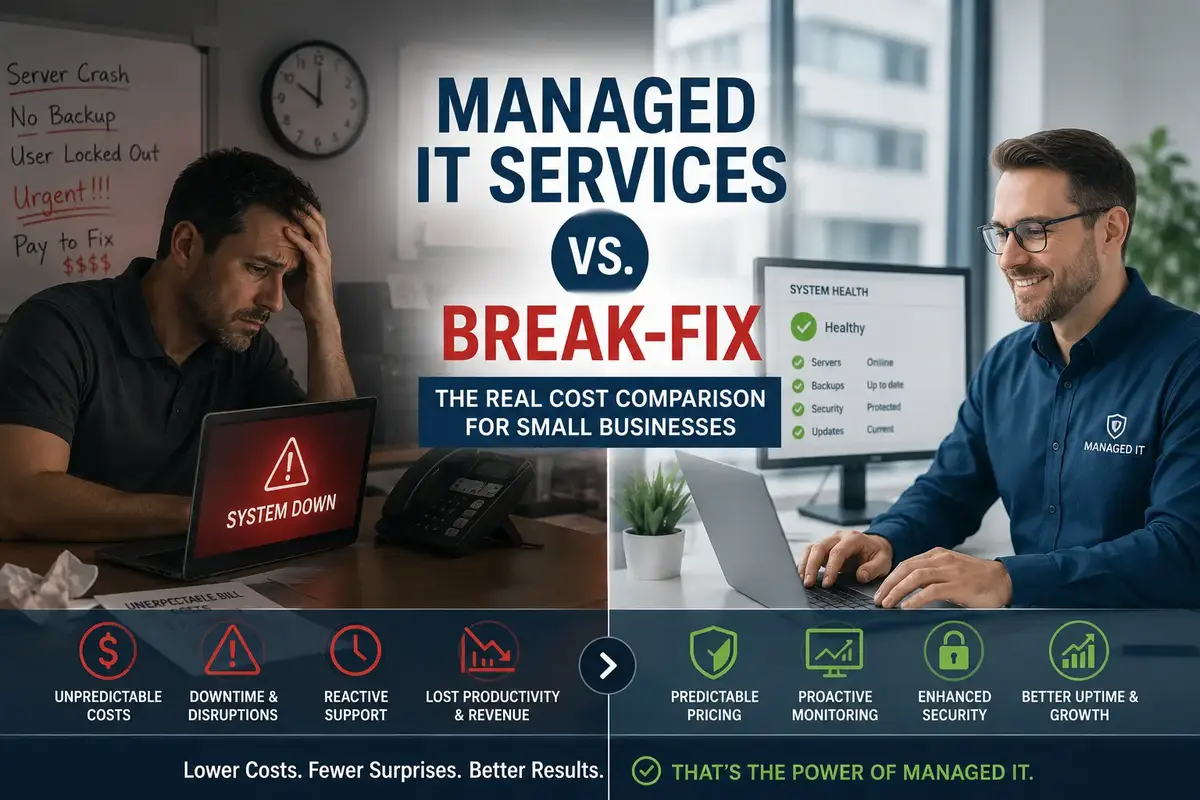
IT Services vs. Break-Fix: Cost Comparison for Small Business
Key Takeaways
- Break-fix looks cheaper until something breaks. One server failure or cyberattack can erase years of apparent savings.
- Downtime costs more than the repair bill. Small businesses lose $137 to $427 per minute during outages. Two hours can cost more than a month of managed services fees.
- Managed IT becomes the better value around the 18 to 24 month mark. Prevented incidents and proactive patching make it cheaper over time for most SMBs.
- 41% of small businesses faced a cyberattack in 2023. Break-fix offers no continuous monitoring. Recovery from an unmonitored attack routinely exceeds $50,000.
- Predictability has financial value. Managed services replace unpredictable repair bills with one flat monthly rate — easier to budget, easier to plan.
What Managed IT Services and Break-Fix Actually Mean
Most business owners have heard both terms. Not everyone knows what they actually mean day to day, or how each fits into a complete IT services strategy.
Break-fix is simple. Something stops working, you call someone, they come fix it, you pay the bill. That’s it. There’s no contract, no monitoring, no one keeping an eye on things between problems.
Managed IT works the other way. One flat fee covers it. Your systems get monitored around the clock, patches go out on schedule, and backups run automatically. Most of the time, issues get handled before your team even notices anything was off.
Cost is the first thing people ask about. Makes sense. Just know that what something costs today and what it costs you over time can look pretty different.
The Hidden Costs of Break-Fix
Break-fix has obvious appeal. Nothing breaks, you pay nothing. The problem is what doesn’t show up in that math.
Emergency Rates Add Up Fast
Planned calls get billed at the normal rate. Emergencies don’t. Nights, weekends, holidays — most providers tack on 50 to 100 percent. An hour of work can run $300 or more, and that clock starts before anyone looks at your system.
The Same Problems Keep Coming Back
Break-fix techs fix what’s broken and leave. No one’s asking why it broke. So the same thing happens again in a few weeks. Another call. Another bill. Repeat.
Downtime Costs More Than the Repair Bill
Per CloudSecureTech’s 2025 research, downtime runs $137 to $427 per minute for small businesses. Run that math on a two-hour outage for a 50-person team and you’re looking at $50,000 in lost work. The repair invoice comes on top of that.
That cost never shows up on a break-fix invoice. It’s invisible until it happens.
Compliance Gaps Nobody Tells You About
Break-fix agreements don’t include backup verification or compliance documentation. For anyone in healthcare, legal, or finance, that’s a real problem. Missing a backup or running unpatched systems can mean regulatory violations. Managed services keep that stuff tracked and auditable. Break-fix leaves it to chance.
Ransomware Recovery Without a Safety Net
Ransomware is one of the most damaging cyber threats targeting small businesses. If it hits and there’s no managed protection in place, you’re starting from scratch. No immutable backups. No incident response plan. Recovery means hiring outside forensics teams, paying for data recovery, rebuilding systems. That regularly runs $50,000 or more, not counting lost revenue or legal exposure.
What You Actually Get With Managed IT
Here’s what most managed IT contracts actually include:
- 24/7 monitoring and automated alerts
- Regular patching and security updates
- Backup testing and disaster recovery verification
- Unlimited help desk support
- Network and firewall management
- Guaranteed response times
No emergency fees. No invoices showing up out of nowhere. One number every month, and a team that already knows your setup.
Running the Numbers: 50-Person Business
These numbers use typical market rates. Your actual costs will vary depending on location, provider, and how serious an incident gets.
Year 1 — Break-Fix
Using $175/hour, 15 incidents a year at four hours each, three after-hours emergency calls, one server failure taking 20 hours, and one two-hour outage.
| Item | Estimated Cost |
|---|---|
| Standard incidents (15 × 4 hrs × $175) | $10,500 |
| Emergency calls (3 × 4 hrs × $262) | $3,150 |
| Server failure (20 hrs) | $3,500 |
| Two-hour outage (productivity loss) | $51,240 |
| Year 1 Total | $68,390 |
Year 1 — Managed IT
50 users at $175/user/month, all services included.
| Item | Estimated Cost |
|---|---|
| Monthly service (50 users × $175 × 12) | $105,000 |
| Emergency surcharges | $0 |
| Surprise invoices | $0 |
| Year 1 Total | $105,000 |
Break-fix looks about $36,600 cheaper, but only because this scenario had a major outage. Without that one incident, break-fix comes in around $17,150, making managed services look six times more expensive on paper. That’s the trap. Break-fix wins right up until the incident that flips everything.
Years 2 and 3
That aging server fails again. Add $4,000 to $6,000. Unpatched systems keep collecting vulnerabilities — the kind of technical debt that quietly inflates your IT budget over time. The same problems keep cycling back.
- Break-fix over three years (one major incident per year): $163,000–$183,000
- Managed IT over three years: $315,000
On pure numbers, break-fix still looks cheaper. But those numbers assume nothing catastrophic happens. One ransomware attack. One bad outage. One compliance violation. Any of those can close the gap overnight. The managed IT number is fixed. The break-fix number has no ceiling.
The Cyberattack Problem
The Hiscox 2023 Cyber Readiness Reportput the share of small businesses hit by a cyberattack at 41%. Median cost: $8,300. Ransomware pushed it higher. Companies that paid the ransom averaged over $16,000, and half of them still didn’t recover everything.
Without monitoring, an attack can sit in your system for days. Nobody sees it until something obvious breaks. At that point you’re hiring outside help, recovering data, and rebuilding from scratch. The bill usually clears $50,000.
Managed IT catches the weird stuff early. Threats get shut down before they move through your network. And if something does get through, clean backups mean you restore your data instead of paying the ransom. One prevented ransomware attack can pay for multiple years of managed services.
Which One Is Right for Your Business?
There are cases where break-fix makes sense. Small team, maybe under 10 people. Not much reliance on technology. Someone on staff who can handle basic issues.Good backups already running. That’s a narrow window.
If your team uses email, shared drives, client records, or accounting software to get through the day, break-fix is a gamble that gets riskier the longer you stick with it.
Managed IT makes sense if your business:
- Depends on technology to function day to day
- Keeps running into the same IT problems
- Is in healthcare, legal, or finance
- Has grown past a handful of employees
- Loses real money when systems go down
Most businesses hit a crossover point somewhere between 18 and 24 months. Before that, managed IT costs more. After it, the prevented incidents and avoided disasters make it the cheaper choice, often by a lot.
How the Switch Works
Most transitions take two to four weeks with no downtime.
Week 1:The provider audits your current setup, identifies gaps, and sets expectations.
Weeks 1–2:Monitoring starts on the most important systems. Break-fix stays in place for everything else.
Weeks 2–4:Everything moves over. Your team learns the new process. The break-fix relationship ends.
Month 2 and beyond:Regular check-ins, SLA reviews, and ongoing improvements.
Frequently Asked Questions
What does managed IT typically cost?
Most small businesses pay $100 to $300 per user per month. For 50 employees, that’s $5,000 to $15,000 a month. Function4 prices based on your actual setup, not a one-size-fits-all package.
When does break-fix actually make sense?
If you have fewer than 10 employees, minimal tech dependence, and someone internally who can manage most issues, it can work. Without redundant systems and solid backups, it still carries risk.
How long does switching take?
Two to four weeks in most cases. The provider audits first, migrates critical systems, and runs both setups in parallel during the handoff. No downtime when it’s done right.
Does the MSP take over all IT decisions?
No. They handle monitoring, patching, backups, and incident response. You keep full visibility through a client portal. Big decisions stay with you.
How does cybersecurity work under managed IT?
Most agreements include endpoint protection, automated patching, backup verification, and 24/7 monitoring. Many cover dark web monitoring and multi-factor authentication too. None of that comes with break-fix. For a fuller look at what protection businesses actually need, see our guide to cybersecurity for business.
Can we start with just part of the services?
Yes. Starting with monitoring and help desk is common. You can add backup and disaster recovery as you go. A phased approach works well for businesses that want to get comfortable before going all in.
What hidden cost do most businesses miss?
Productivity loss during downtime. The repair invoice is visible. The cost of 50 employees who can’t work for two hours isn’t. That number is often bigger than the repair bill.
Is hardware replacement included?
Usually not. Hardware gets handled through separate upgrade planning. The managed IT agreement covers monitoring, support, and software.
Ready to Know What It Would Actually Cost You?
Function4 does free IT assessments for Southeast Texas businesses. You’ll get an honest look at what you’re spending now, where the risks are, and what managed services would mean for your bottom line.
Schedule your free assessment: (346) 270-2334
