





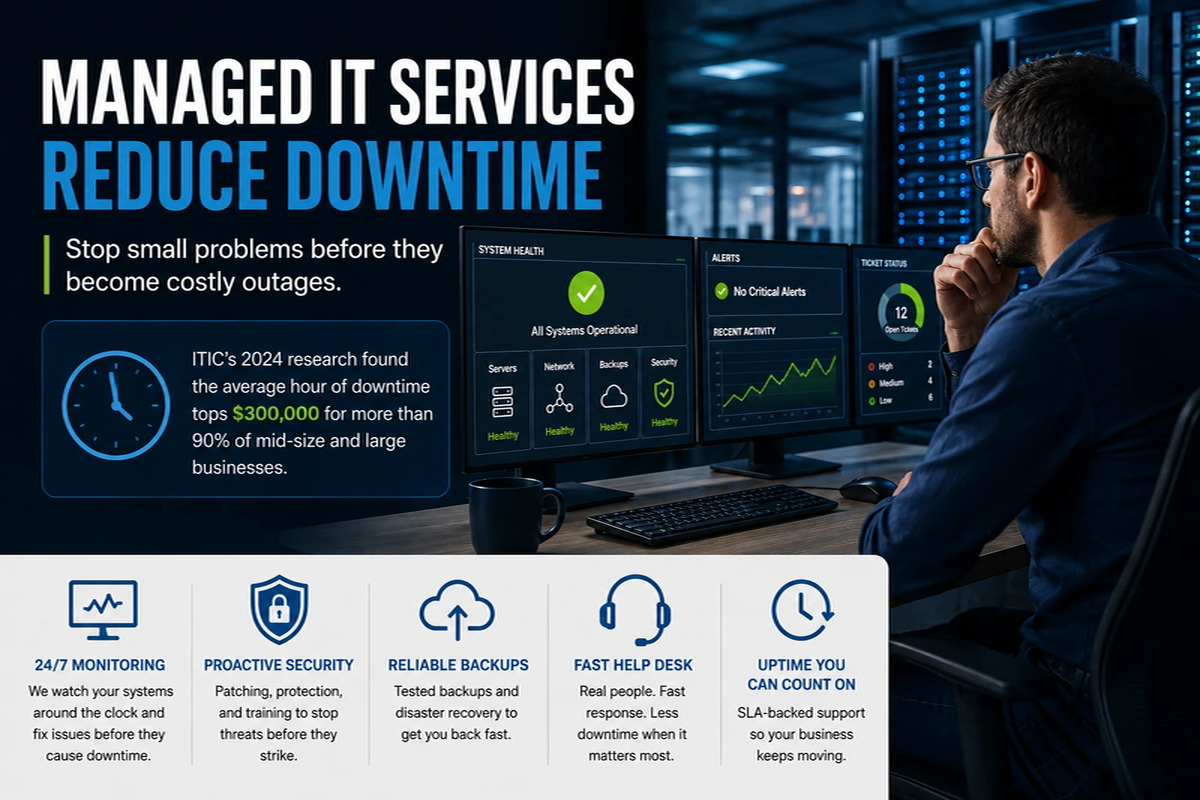
Managed IT services reduce downtime by catching the small failures before they turn into the outage that stops your business. That’s the whole pitch. And it matters more than most owners think, because downtime is expensive. ITIC’s 2024 research found the average hour tops $300,000 for more than 90% of mid-size and large firms.
Your office won’t hit that. But you’ll bleed money faster than you’d guess once payroll keeps running and the work doesn’t. The catch? The bill never lands in one place. It’s scattered across a dozen lines nobody adds together.
So let’s add them up. Then let’s talk about how to stop it.
Key Takeaways
- Managed IT services reduce downtime by catching the small stuff before it becomes the outage.
- ITIC pegs the average downtime hour above $300,000 for 90%+ of mid-size and large firms. Smaller shops lose less, still thousands.
- Two costs you can see: idle payroll and lost revenue. Then a longer list of ones you can’t.
- Hardware quits, people slip, attackers strike. Those three cause most outages.
- There’s a calculator below. Run your own number in about a minute.
What Counts as “Downtime”?
Downtime is any stretch where your systems are down and the work stops. Two kinds.
Planned downtime you schedule. Overnight patch, a software upgrade, low drama. Unplanned is the one that hurts. A server dies at 2pm. Ransomware locks the files. The internet drops during your busiest hour.
And the costs split too. Hard costs show up on a spreadsheet, like lost sales and the hours you pay someone to fix it. Soft costs are sneakier. A blown deadline. A customer who quietly stops calling. Those don’t invoice themselves, but they cost more over a year than the stuff that does.
How Much Does Downtime Actually Cost?
Bigger than most people guess. Here’s the data.
ITIC’s 2024 Hourly Cost of Downtime survey found 97% of large enterprises put one hour above $100,000. For 90%-plus of mid-size and large firms, the average hour now clears $300,000. The only companies that came in under $100,000? Micro-shops with fewer than 10 people.
Your business sits somewhere on that scale. The math is the same either way. Count the people who can’t work, times what they cost you per hour. Add the revenue you’d have booked in that window. That’s your floor, and it’s before any of the hidden stuff below.
Downtime Cost Calculator
Don’t take my word for it. Run it:
Headcount, wages, revenue, how often outages hit. It spits back your cost per hour, per incident, per year. The annual number is the one that makes people sit up.
The Hidden Costs Most Businesses Miss
The per-hour figure is the tip. Underneath:
- Recovery labor. Somebody rebuilds, restores, and tests after the lights come back. That’s hours you’re paying for twice.
- Lost data. Anything created since your last clean backup can just be gone. Now you’re recreating work you already paid for.
- The customer who doesn’t come back. They couldn’t check out today. Tomorrow they’re somewhere else.
- Your reputation. B2B clients notice when a vendor goes dark at 10am on a Tuesday. Word gets around.
- Fines. In a regulated industry, an outage that leaks data brings penalties on top of everything else.
Tally a year of that and the real cost of downtime often runs double the raw hourly figure.
Top Causes of IT Downtime for Small Businesses
Can’t fix what you can’t name. Five causes do most of the damage.
- Hardware failure. Old servers and drives quit without a warning. That aging box in the closet is behind a lot of “sudden” outages.
- Human error. Someone fat-fingers a setting or deletes the wrong folder. It happens. Untrained access just makes it happen more.
- Cyberattacks. Ransomware is downtime by design, then a bill to make it stop. The FBI’s 2024 Internet Crime Report logged $16.6 billion in losses, up a third in one year, with thousands of ransomware complaints from businesses. Solid cyber security services shrink that risk fast.
- Power and network trouble. Storms and ISP outages are just part of doing business across Texas, Louisiana, and Oklahoma. Redundancy is how you ride them out.
- Systems nobody patched. Miss the updates and you leave known holes wide open. Attackers scan for exactly that.
See the pattern? Almost every one of these is preventable.
How Managed IT Services Reduce Downtime
This is where a partner earns the check. Managed IT services run on one idea. Kill the small problem before it grows into the outage.
What that looks like day to day:
Somebody’s watching. Monitoring runs around the clock. A drive that’s about to fail gets flagged and swapped before it takes your morning down with it.
Patches go out on schedule. Not whenever someone remembers. That closes the holes attackers look for.
Backups you can actually trust. Tested ones. So an outage is an annoyance, not a funeral. When it goes really wrong, cloud backup and disaster recovery puts you back on your feet quick.
A help desk that picks up. When something breaks, fast help desk support is the difference between ten minutes and half a day. Minutes add up.
An SLA in writing. A number on response and fix times. You know what you’re getting instead of crossing your fingers.
Fewer outages. Shorter ones when they slip through. That’s the whole job.
Downtime and Cybersecurity: The Overlap
Let’s be blunt. A ransomware attack is a downtime event. Same problem, different hat.
When attackers encrypt your files, every locked-out hour is downtime, and the ransom rides on top. That’s why you can’t plan for one without the other. Endpoint protection, staff training, tested backups. They cut your breach risk and your outage risk in the same move.
What to Look For in a Downtime-Ready IT Partner
Not every provider keeps you running. Some just show up after the fire. Quick gut-check before you sign:
- Are they watching your systems 24/7, or waiting for your call?
- Backups automated, offsite, and actually tested? Or just assumed?
- Is there an SLA with real numbers in it?
- Can one team handle IT, security, and connectivity? Or are you about to juggle three vendors?
- Do they know your region and your line of work?
Yes across the board means you’ve found people who treat uptime as the product.
Conclusion: Uptime Is Cheaper Than Downtime
Downtime’s easy to ignore. Right up until the afternoon it stops everything cold.
So run the calculator. Look at the yearly number, then set it next to what prevention costs. For most businesses around here, proactive IT pays for itself the first outage it kills. Function4 keeps companies across Texas, Louisiana, and Oklahoma up and running, so your team worries about the work instead of the network. Want to know where you stand? Get a free IT assessment and we’ll map your risk.
Frequently Asked Questions
Understanding the cost of downtime
How much does one hour of downtime cost a small business?
Depends on your size and what you do. ITIC’s 2024 numbers put the average hour above $300,000 for most mid-size and large firms. A small office loses less, but still thousands once you count idle payroll and the sales you didn’t make. The calculator above gives you your own figure.
How do you calculate the cost of downtime?
Start with lost productivity: people who can’t work, times their hourly cost, times how much of the day is actually stopped. Add lost revenue, which is your annual revenue split across working hours. Then multiply by how long and how often you go down. That’s your per-incident and per-year exposure.
Planned vs unplanned downtime, what’s the difference?
Planned is the maintenance you control. Off-hours, low stakes. Unplanned is the surprise, from a failure or an attack, and it lands in the middle of your business day. That’s where nearly all the cost lives.
Why is downtime always more expensive than people expect?
Because they only count the obvious part. The recovery hours, the lost files, the customer who walked, the dinged reputation. Nobody adds those to the invoice. But they’re often bigger than the hourly loss you did count.
Does every industry lose the same amount?
No, and it’s not close. A healthcare or e-commerce operation bleeds far more per hour than a quiet office. And if you’re regulated, a data-exposing outage stacks fines on top of the loss.
Reducing and preventing downtime
How do managed IT services reduce downtime?
Two ways. They prevent outages with round-the-clock monitoring, scheduled patching, and tested backups. And when one slips through anyway, fast help desk response and a real SLA keep it short. The model’s built to catch trouble early.
What causes most IT downtime?
Hardware that fails, people who slip, attackers who strike, power and network hits, and systems nobody updated. Good news? Almost all of it is preventable with steady maintenance and gear that isn’t ancient.
Do backups really help if the goal is uptime?
They don’t stop the outage. But they gut how long it lasts. A tested offsite backup turns a multi-day rebuild into a restore you measure in hours. After ransomware, that’s the whole ballgame.
How fast should a provider respond when you go down?
Fast enough that it’s written down. Look for committed response and resolution times in the SLA, not a vague promise to get to it. Ask for the numbers before you sign anything.
Is it worth paying for managed IT just to avoid downtime?
For most businesses, yeah. Put the calculator’s annual number next to a monthly IT plan. Prevention usually pays for itself the first outage it stops.
