





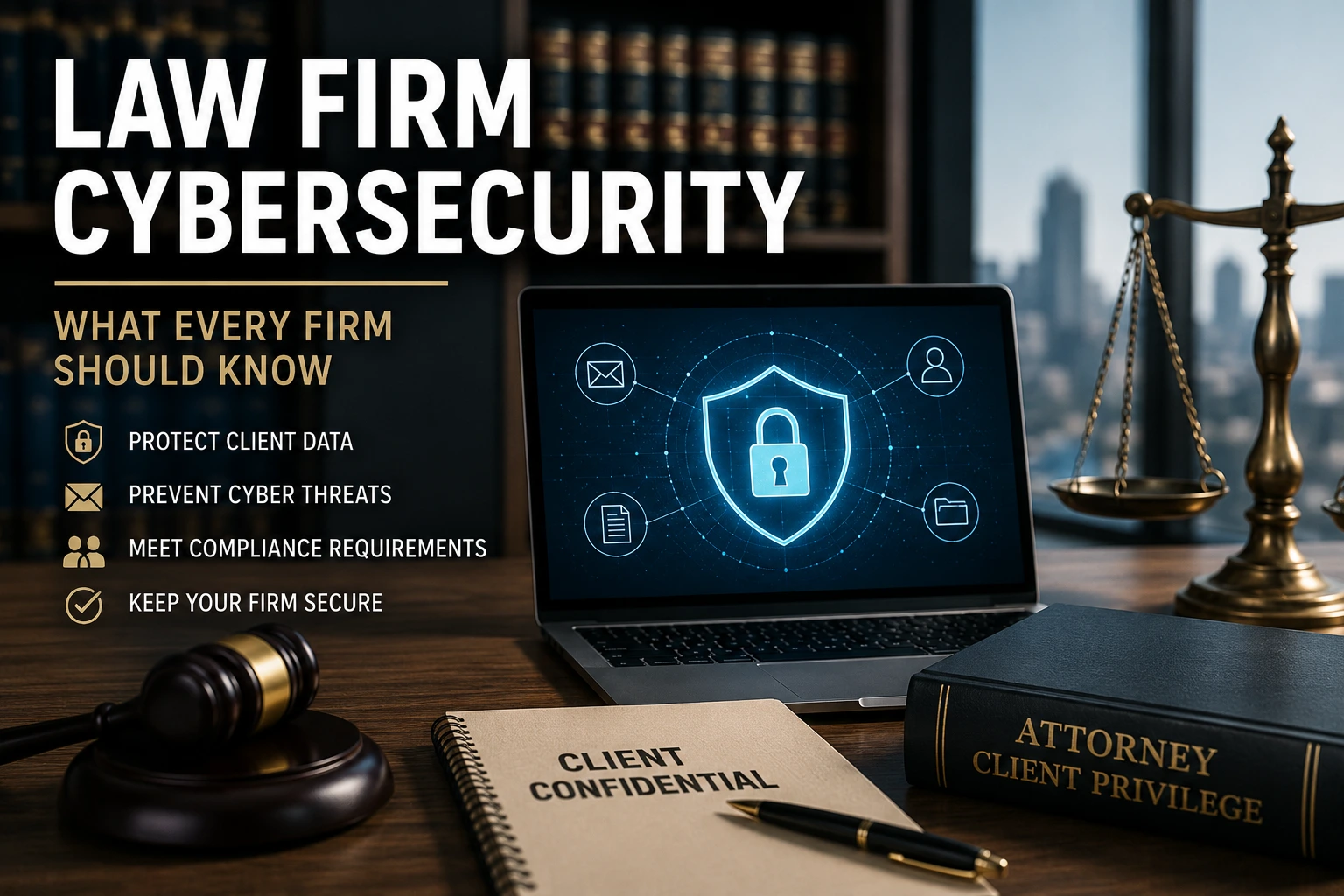
Every law firm sits on information other people want badly: settlement figures, medical records, financial disclosures, complaints nobody’s filed yet. High sensitivity plus obvious value is a rough combination, and it makes firms a bigger target than a lot of small and mid-sized businesses realize.
Most firms don’t picture themselves as a “cybersecurity risk” the way a hospital or a bank does. But an attacker doesn’t need to get into a Fortune 500 company to make money off this. A mailbox full of privileged correspondence at a firm too busy litigating to think about firewalls works just fine.
Below is what puts law firms at risk, what real protection looks like day to day, and what firms are on the hook for when it comes to compliance.
Key Takeaways
- Law firms are high-value targets because they concentrate sensitive data — settlement figures, medical records, financial disclosures, non-public deal terms — often with lighter defenses than the corporate clients they represent. Attackers breach the firm as a shortcut to the client.
- Business email compromise is the #1 way firms get breached. A spoofed message posing as a partner, client, or opposing counsel tries to redirect a wire or extract privileged files.
- Small firms are hit just as often as large ones — sometimes more, because attackers assume their defenses are thinner relative to what they protect.
- Real protection is layered, not a single product: multi-factor authentication, endpoint protection and monitoring, encrypted email and secure file sharing, dark web monitoring, and staff security awareness training.
- The highest-impact, lowest-cost first move is multi-factor authentication — it makes a stolen password worthless on its own.
- Compliance is a standard, not a checklist. The ABA Model Rules require “reasonable efforts” to protect client information, scaled to firm size and data sensitivity. Documented safeguards are the evidence a firm took that obligation seriously.
- Corporate clients increasingly require it. Security questionnaires and technical benchmarks are becoming routine before regulated-industry clients share sensitive matters — a firm with nothing documented can lose the business regardless of the quality of its legal work.
Why Law Firms Are a Bigger Target Than Most Businesses
Attackers go after firms for a simple reason: it’s a shortcut. Rather than breach a corporation directly, an attacker who gets into that corporation’s outside counsel can often reach the same deal information, litigation strategy, or personal records. And usually with a lot less resistance standing in the way.
The Data Firms Hold Without Thinking About It
One litigation file can have medical records, financial statements, Social Security numbers, and confidential settlement terms sitting in it. One corporate deal file can hold non-public financial information a competitor, or someone trading on inside information, would love to get their hands on. Firms pile this data up constantly, and a lot of them don’t have a real process for deciding how long to keep it or who still needs access.
Email Is the Most Common Entry Point
Business email compromise is still the way most firms get hit. An attacker poses as a partner, a client, or opposing counsel, then tries to redirect a wire transfer or pull sensitive files. Attorneys send and receive a huge volume of email every day, usually in a hurry, and a convincing fake slips through in exactly that kind of environment.
The Core Pieces of Law Firm Cybersecurity
No single product covers cybersecurity for a law firm. It takes a handful of layers, each one closing off a different way in.
Multi-Factor Authentication
A second verification step beyond a password means a stolen or guessed password on its own doesn’t get anyone into email or a case management system. It’s cheap, fast to set up, and still one of the better returns on effort a firm can get.
Endpoint Protection and Monitoring
Every laptop, desktop, and phone an attorney uses to reach firm systems is a way in. Endpoint protection watches those devices for anything that looks off and can cut a compromised machine off before whatever’s on it spreads across the network.
Encrypted Email and Secure File Sharing
Regular email was never built to carry confidential legal correspondence. Encryption means that even if a message gets intercepted, whoever grabbed it can’t read it, which matters a great deal when the message includes settlement numbers or a client’s financials.
Dark Web Monitoring
Credentials leaked somewhere else tend to resurface for sale on the dark web eventually, and attorneys reuse passwords like everyone else does. Monitoring for a firm’s own leaked credentials gives someone a chance to reset a password before it gets used against firm systems.
Security Awareness Training
Technology can only do so much here. Regular training on spotting phishing attempts and odd requests covers the gap software can’t, because one click from a busy paralegal can undo everything else a firm has in place.
What Compliance Actually Requires
No single cybersecurity law governs law firms the way HIPAA governs healthcare providers. What firms answer to is a mix of professional ethics rules, plus whatever industry-specific requirements come along with their client base.
ABA Model Rules and State Bar Obligations
The American Bar Association’s Model Rules of Professional Conduct require attorneys to make “reasonable efforts” to keep client information from falling into the wrong hands. No checklist spells out what counts as reasonable.
It moves with firm size, how sensitive the data is, and what security measures are available and affordable at that point. Documented safeguards like MFA, encryption, and monitoring matter because they’re evidence a firm took the obligation seriously, not just a box to check.
Client-Driven Security Requirements
More and more, corporate clients want outside counsel to fill out a security questionnaire or hit specific technical benchmarks before they’ll hand over sensitive matters. That’s especially true in finance, healthcare, or other regulated industries. A firm with nothing documented can lose that business alone, no matter how good the legal work is.
Frequently Asked Questions about Law Firm Cybersecurity
Why do cybercriminals specifically target law firms?
Firms sit on concentrated, high-value information, settlement details, financial disclosures, non-public deal terms, usually with fewer security resources behind it than the corporate clients they represent. That gap is what makes them worth targeting.
What’s the most common way a law firm gets breached?
Business email compromise, by a wide margin. A spoofed message pretending to be a partner, client, or opposing counsel, built to redirect a payment or talk someone into handing over sensitive files.
Do small firms actually need to worry about this, or is it mainly a large-firm problem?
Small firms get hit just as often, sometimes more. Attackers tend to assume smaller firms have thinner defenses relative to what they’re protecting, and that assumption is usually right.
What’s the single highest-impact security measure a firm can add?
Multi-factor authentication, hands down. It’s the cheapest, fastest way to make a stolen password worthless on its own.
Is encrypted email really necessary, or is a strong password enough?
Different problems. A strong password keeps someone from logging into an account. Encryption protects the message itself while it’s in transit, which matters if it contains settlement figures or client financials.
How does dark web monitoring help a firm?
It flags a firm’s own credentials if they show up in a breach dataset somewhere else online, so someone can force a password reset before it gets used against firm systems instead of after.
What are the ABA Model Rules’ actual cybersecurity requirements?
“Reasonable efforts” to prevent unauthorized access to client information, that’s the standard. It flexes with firm size and how sensitive the data is rather than handing firms a fixed technical list.
Can corporate clients require a law firm to meet specific security standards?
Yes, and it’s becoming routine. Plenty of corporate clients, particularly in regulated industries, ask outside counsel to complete a security questionnaire or meet documented standards before sharing anything sensitive.
Where should a firm start if it has no formal cybersecurity measures in place?
MFA and a basic endpoint protection tool first, those are the fastest wins with the least disruption. Follow it with a security awareness session for staff.
What’s the best first step for a firm that isn’t sure where its gaps are?
Get a cybersecurity assessment from an IT provider who’s worked with legal workflows before. It’s the most direct way to find out what to prioritize instead of guessing.
Law Firm Cybersecurity
Good law firm cybersecurity doesn’t mean buying every product on the market. It means closing the specific gaps that make firms a target in the first place: weak email protections, devices nobody’s watching, and staff who haven’t been shown what a convincing fake looks like. Multi-factor authentication, endpoint monitoring, encrypted communication, dark web monitoring, and staff training cover most of the real-world risk. Together, they let a firm back up its “reasonable efforts” obligation instead of just claiming it.
None of this turns a law firm into a security company. It takes an honest look at where the risk sits, plus an IT partner who gets that a law firm’s technology needs don’t look like a typical small business’s. One Houston law firm found that out when it moved its entire case file system to a secure, paperless setup.
Business email compromise (BEC): An attack in which a criminal impersonates a trusted contact, such as a partner or client, over email to redirect funds or extract sensitive information.
Multi-factor authentication (MFA): A login process requiring a second form of verification beyond a password, such as a code sent to a phone.
Endpoint protection: Security software that monitors individual devices (laptops, desktops, phones) for suspicious activity or malware.
Dark web monitoring: A service that scans dark web marketplaces and breach databases for an organization’s leaked credentials.
Reasonable efforts (ABA Model Rules): The flexible standard attorneys are held to under the ABA Model Rules of Professional Conduct for protecting client information, scaled to firm size and data sensitivity rather than a fixed checklist.
Business associate (HIPAA): An organization that handles protected health information on behalf of a covered entity, a status some law firms hold depending on their client work.
See What IT Support Built for Law Firms Looks Like
Curious how all this comes together for a legal practice? Take a look at our IT support page to see Function4’s managed IT and cybersecurity services built around how law firms operate. Or grab a free technology consultation to find out where your firm’s gaps are.
